2026.007.01 - Wheelbarrow
Parking at the Goldhanger Sailing Club is discouraged and the nearest road parking now has a three hour limit.The means that you have to park up the village somewhere. This in itself is not a problem, it is the walk from where you park to the club which can be between 1km and 2 km. If you have a lot of things to carry then this can be awkward. My normal kit would be a cool box, wellies, carry bucket, rucksack, one or two drones, possibly a holdall, oars and a fleece jacket.
So I decided to use the spare pair or yellow wheels left over from another project to build a wheelbarrow...sort of.

This is the result. Two wheels on a metal axle fixed to a wooden batten which is screwed to the bottom of a stacking plastic crate.

The screws were backed by fairly large washers to spread the load as the plastic is not very thick on the bottom.

Very agricultural but works.

The idea is that the oars will form the handles.

To this end I made up two wooden sleeves that will be screwed to the sides of the crate.

The tip of the oar slots into the pocket at the aft end of the sleeve and the front of the blade slips between two angled blocks.

When fitted, a bungee cord is wrapped around the oars to stop them falling out of the sleeves.

The result is basic but appear to do the job. I have more of the crates and can stack them up as required.
My next visit to Naiad will bw interesting.
Time for a cup of tea.
2026.06.25 - Lost VHF Radio
Back in October of 2022 I finally decided to buy a handheld marine VHF radio. I had been vacillating over the purchase for a number of months, reviewing different radios on line, eventually settling on an Icom M94DE.

This is the radio and you can find the details about it here: https://icomuk.co.uk/IC-M94DE/...
It is a very nice unit and I was pleased with the radio when it arrived. The only problem being that I could not use it. Well, I could but I was not allowed to as my old marine VHF radio from way back in 1988 did not cover this radio as it features DSC, or Digital Selective Calling.
Fortunately for me, the West Mersea Yacht Club ran the VHF licence courses on a regular basis, so I signed up for the next one, attended, passed and duly received my new certificate.
Great. From then on I took the radio with me when sailing as its primary use is not for calling up other boats and harbour masters and so on, but as a safety aid.
But then, less than a year later, I lost it. I got home from sailing one weekend and no radio. I could not find it anywhere. The next time I went down to the club I asked if anyone had found it and handed it in, checked on Naiad all to no avail. This was quite a blow since it was not a cheap model, costing £325 back then.
So, in the end I bought a new one. This one costing me £320. And I have used it ever since.
And that brings me to today.
In my home office I have an armchair from my parents old house that did not fit into their new one and was too good to throw away. It's covered in blankets so that the cats don't scratch it and I was rearranging the seat cushion whilst trying to read some code when I found something hard down the right hand side. I pulled out a M94DE VHF radio.
Strange, I thought, I was sure that I had put it into the charger in the other room when I returned from sailing last weekend and thinking no more about it I took the radio into the workroom to put it into the charger and found that I had not forgotten to put it into the charger last Sunday evening. Instead I had found the radio I lost nearly three years ago!

So, now I have two.
I kept the charger and cables from the original one even though I thought it had been lost.
The thing is, I don't need two.
I wonder if anyone I know in the sailing world needs a VHF Radio?
2026.05.17 - Launch Considerations
There are two ways to launch and recover a boat from the Goldhanger Sailing Club and for the first launch at the club I don't want to do either of them. This is mainly due to not knowing how to use the club facilities. So, Plan A will be to launch from the public hard at West Mersea. The weather window looks good for Thursday the 21st May with high tides at 04:00 at Mersea and 16:50 at Osea Island. This means a Wednesday afternoon or late night drive to rig Naiad, put her in the water in the water and get out of the Mersea channels well before low water at 10:00. This would then allow a trip up the Blackwater on the rising tide.
The fly in the ointment is the predicted wind direction. The forecast has this as just South of West force 4 gusting 6 on Wednesday afternoon and early evening, moderating overnight to 3 gusting 4. This make the Public Hard at West Mersea a lee shore and those are always difficult to sail from in the best of conditions.
So, Plan A was scrapped and Plan B created.

This is one of the two public hards at Tollesbury at low water. In the forecast wind direction this is a weather shore. That it the wind blows off the land and on to the sea. The opposite of the lee shore at West Mersea. Perfect.

This is a closer look and the only obstruction is the sill at the entrance of the marina and that is where the green marker stands in the mud. The sill is concrete and not something you want to hit. Still, the launch will be at high water so there should be little chance of touching it.

This is the way out, the Woodrolfe Creek and the forecast wind will be blowing along this creek and will blow Naiad along nicely.
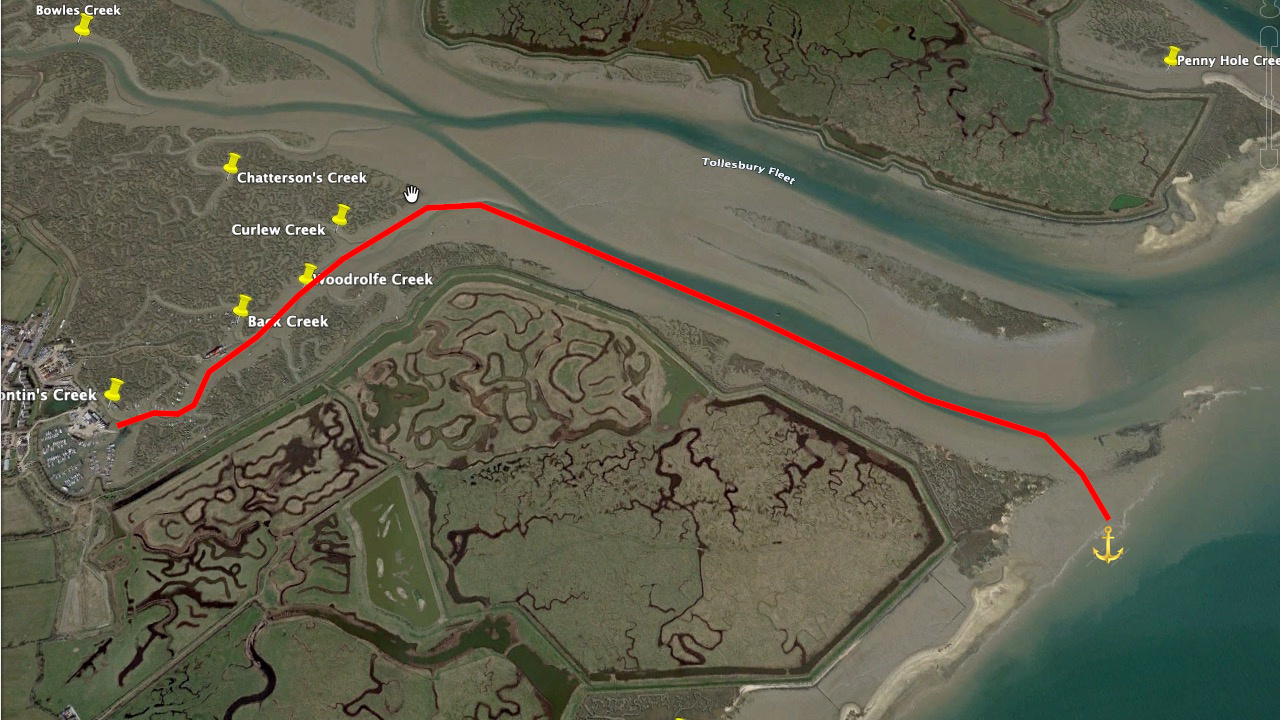
This is a screen capture of Google Earth showing the area in question. Tollesbury is on the left of the image. Naiad will be launched just where you can see the words 'ontin's Creek' (the 'B' is off screen). This is a low water shot and Woodrolfe Creek is just mud at this point. But at high water, Naiad will sail along the creek to the end, turn right, sail down the southern arm of Tollesbury Fleet, cut across the mud bank at Shinglehead Point and anchor where the I placed the anchor symbol....more or less.. following the red line.
If the wind is still strong I may see if there is a vacant buoy in the South Channel until the flood during the night has moderated, as per the forecast, and then sail out over the mud bank and anchor. I'll make that determination once I'm sailing.
Still, I'll spend the night on board, a lovely thought, and wait for the low tide on the Thursday morning. Then up anchor and sail up the Blackwater to Goldhanger.
That's plan B.
Plan C is to wait until another weather window.
Time for a cup of tea.
2026.05.17 - More Trailer Mods.
There are just a few more modifications to carry out on the travelling trailer before Naiad can be strapped in place for the trip down to the River Blackwater.

The previous roller at the bows was replaced with a better one and you can see that the 'wings' of the vee protect the boat from the metalwork.

There is a section of the hull that used to be supported by the rollers, but those have been removed and I wondered about putting in a support just for when the trailer is moving.

So I made one from scaps of plywood. It's that big chunky thing. The four bilge runner supports were extended, the extensions being glued in place with domino tenons.

This how they look when placed on the trailer.

All four were bolted in place before being covered with preservative. You'll notice that Naiad is just hanging in the slings at this point. I did put some blocks under her stern and used the two aluminium steps as bilge runner supports. None of these are touching but if anything happens she only has about an inch to fall.

The heads of the bolts were recessed into the supports such that they will not damage the hull.

The next modification was to add stop blocks which will prevent the boat from slipping sideways. Well, not too far. These will be bolted into position after the boat has been recovered onto the trailer.

As before, the bolt heads were recessed. These bolts are inserted into holes in the supports that have been threaded using a wood-threading bit and give a surprisingly good grip.

The aft stop blocks are the same as for the fore stop blocks.

The inner bolt is a little tricky to get in place as the hex key can only be used for half a turn before it hits the hull. Still, it does the job and that's all that counts. Now all four stop blocks need to be covered with preservative.
Time for a cup of tea.

Whilst the stop blocks were drying, I removed the cranes and started the process of lashing Naiad down to the trailer and making her ready to travel. This included packing all the bits and pieces into the minibus.
One thing I did a few days before putting Naiad onto the trailer was to try out Shoal Waters' old foresails.

The first question did they fit lengthways? As you can see they did.

Since it was a calm day I unfurled the sails as well.
Now why am I doing this?
The answer to that is that the foresails I have for Naiad are not correct. If I unfurl the jib, the one at the very front of the boat, it does little to aid the sailing. Most of the time that sail just tries to force the boat around. There is a very small window where the sail works, but it is very small indeed. Off the wind, that is with the wind coming from the back half of the boat, the sail could be used, but not otherwise.
Since I have both sets of sails I measured them and compared them and Shoal Waters' sails are all smaller in area except for the staysail.
These are the sail areas in square feet:
| Sail | Shoal Waters | Naiad |
| Mainsail | 86.7 | 98.3 |
| Jib | 18.8 | 22.7 |
| Staysail | 17.4 | 16.7 |
The plan is to try Shoal Waters' headsails on Naiad and see how she sails. It might mean retaining Naiad's smaller staysail, but time will tell. The difference between the main sails is not likely to be a problem and Naiad's main is just 13% larger than Shoal Waters'.
Time for a cup of tea.
2026.05.10 - Continuing the Trailer Mods.
The weather forecast for the day was bright and sunny and fairly warm and since the forecast for the rest of the following week was cold, overcast and wet, it was time to get the gantry cranes reassembled and Naiad suspended over the trailer before the rain set in.

Putting the cranes together took longer than I anticipated as I found that I had only marked half the components and fitting the rest together turned out to be a 'try everything and see what fits' exercise. Still, I mananged in the end. The gaff and boom on Naiad were removed, the mast lowered and the cranes put in place.

The chain hoists and strops had to be carefully placed so as not to have the strops trapped between the boat and the trailer. This also meant that they were a little further apart than I would have liked.

The lifting began with frequent checks to make sure that the boat was only lifted far enough to get the trailer underneath.

Lifting the boat in slings is always a trial. Even though I know that the cranes are capable of lifting Naiad easily, I'm always concerned about her slipping out of the strops or otherwise falling to the ground. So much so that when running the trailer underneath the boat, I only remove the blocks upon which she has rested these last few months when they impede the trailer. Then, if something does go wrong, she only has s few inches to fall and then onto wood and not concrete.

Eventually, she was over the trailer as you can see here.

She was gently lowered until the keel rested on the two main load-bearing cross timbers.

The two new cross timbers were then adjusted upwards until they too touched the keel.

The supports for the bilge runners were then cut to size.

These were cut to be a little shorter than required, leaving a 5mm gap, more or less, between the block and the runner. These are not there to take the weight of the boat, but to stop the hull from leaning over. Having that gap ensures that they do not end up under load. If there is too much gap, bearing in mind that all the timbers are softwood and will expand and contract in the humidity and from being in the water, then I'll just add temporary shims to fit.
The next tasks are to add extensions to the timbers such that they reach the outer edge of the timbers upon which they rest, I didn't have timber long enough to make these in one piece without having to cut into a new longer length, but I did have shorted lengths and hence the compound result. Then the new supports will need to be coated in preservative and fixed to the timbers when that is dried.
Finally, I have to make four removable stops that will fit on top of these new pieces which will be fitted once the boat in positioned correctly on the trailer and will prevent the boat from slipping sideways during transit. That is the disadvantage over this new system, the boat does slide sideways easily. This is good in one sense as it means that positioning the boat on the trailer during hauling out is easy, but this is not a good thing when towing the trailer.
Time for a cup of tea.